
A Golden Wire is a period instrument ensemble which seeks enliven old music with a fresh sound for new audiences. Under the leadership of the award winning gambist Arnie Tanimoto and harpist Parker Ramsay, the ensemble collaborates with musicians from around the globe to excite audiences and shed light on the sounds of the past.
The ensemble makes its home in New York, producing its own concerts and partnering with institutions across the city, including the Metropolitan Museum of Art, the Brooklyn Public Library, the Bohemians, the Zürcher Gallery, and Aspect Chamber Series. They also perform across the United States, appearing before audiences at Chatham Baroque, PS21, Museum Concerts in Providence, the Elm City Consort and Bach Ascending.
A Golden Wire specializes in 17th century music of England and the British Isles, where the harp and viol were particularly prominent. The ensemble’s repertoire also spans further, from the German Renaissance, to the high Baroque in France and Italy.

Gold medalist and first-ever American laureate of the International Bach-Abel Competition (2018) Arnie Tanimoto has quickly established himself as one of the foremost viol players in the United States. He has performed and recorded in venues across North America and Europe with the likes of Barthold Kuijken, the Boston Early Music Festival Ensemble, and the Smithsonian Consort of Viols. Arnie is a core member of Mountainside Baroque and a founding member of
he Academy of Sacred Drama. Alongside harpist, Parker Ramsay, he co-directs A Golden Wire.
Arnie was the first-ever viola da gamba major at the Juilliard School, where he soloed on both viola da gamba and baroque cello. In 2017 he was awarded with a Frank Huntington Beebe Fund Fellowship and subsequently finished his studies at the Schola Cantorum Basiliensis in Basel, Switzerland. His principal teachers include Paolo Pandolfo, Sarah Cunningham, Christel Thielmann, and Catharina Meints. He holds additional degrees from Oberlin Conservatory and the Eastman School of Music.
Arnie serves on faculty at The Juilliard School and Princeton University, as well as maintaining a private studio. He also regularly teaches at the Mountainside Baroque Summer Academy and the Viola da Gamba Society Conclave.
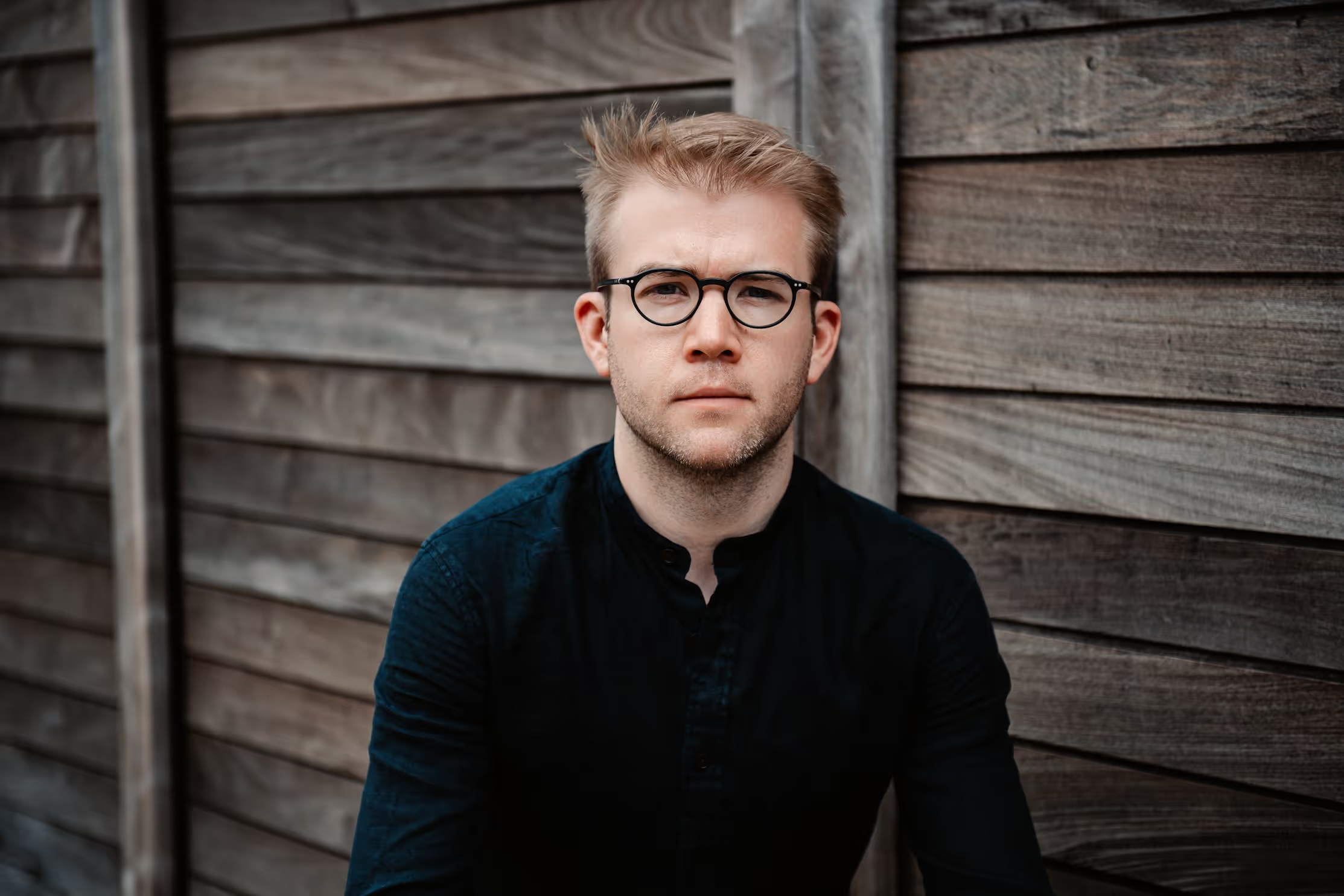
Parker Ramsay has forged a career that defies classification. Whether premiering, rediscovering, or transcribing, he dedicates himself to expanding the harp’s repertoire, bringing the instrument to conversations — and audiences — it had never before known.
Ramsay has given solo performances at Alice Tully Hall, the Miller Theatre at Columbia University, The 92nd Street Y, the Phillips Collection, Cal Performances, Shriver Hall, IRCAM, King’s College, Cambridge, the Spoleto Festival USA, and the Center for the Art of Performance at UCLA. He has collaborated with ensembles such Mark Morris Dance Group, Apollo’s Fire, and the Van Kuijk Quartet, and has undertaken residencies at the University of California, San Diego, Princeton University, and IRCAM. Ramsay’s 2020 recording of Bach’s Goldberg Variations was praised as “remarkably special” (Gramophone), “nuanced and insightful” (BBC Music Magazine), “relentlessly beautiful” (WQXR), and “marked by a keen musical intelligence” (Wall Street Journal); he celebrated the album’s release with a performance at the Phillips Collection in Washington, D.C.
Raised in Tennessee, Parker began harp studies with his mother, Carol McClure. He served as organ scholar at King’s College, Cambridge before pursuing graduate studies at Oberlin and Juilliard. In 2014, he was awarded First Prize at the Sweelink International Organ Competition in Amsterdam. He lives in New York City and is pursuing a Ph.D in historical musicology at Columbia University.

Thomas Fields performs both on viola da gamba and historical cello as a chamber musician and soloist. In 2025, he won first prize at the 13th International Telemann Competition, becoming the first-ever gambist to receive this distinction. He performs throughout Europe and North America, including at festivals such as the Utrecht Early Music Festival, the Heinrich Schütz-Musikfest, and the Munich Residenzwochen. With his ensemble False Consonance, he won the title of "Rheinsberger Hofkapelle" in 2024 and was ensemble-in-residence at the historic Rheinsberg Palace during the 2024-2025 season.
After completing his studies in modern cello in the USA, he studied with Prof. Hille Perl (viola da gamba) and Prof. Olaf Reimers (historical cello) at the University of the Arts Bremen. He also completed postgraduate Meisterklasse studies in viola da gamba at the University of Music Würzburg with Prof. Friederike Heumann, which he finished summa cum laude. Thomas lives Bremen, where he and his ensemble founded the concert series “Alte Musik im Focke” in the Bremen State Museum.

Lucine Musaelian is an Armenian-American viola da gamba player, singer, and composer from New Jersey. She graduated from Yale University in 2020 with a BA in Music, where she was a member of the Yale Schola Cantorum, Elm City Consort, the Opera Theatre Company of Yale, the Yale Collegium Musicum, and the Smithsonian Consort of Viols. In July 2022, Lucine completed her MA in Historical Performance at the Schola Cantorum Basiliensis in Basel, Switzerland, where she studied viola da gamba with Paolo Pandolfo and voice with Rosa Dominguez. She continued her viol studies with Jonathan Manson at the Royal Academy of Music, where she completed a Professional Diploma in Viola da Gamba Performance as a recipient of the Enlightenment Award. Lucine is now a Royal Academy Chamber Fellow with the duo Intesa.
Lucine has performed under the direction of celebrated conductors like René Jacobs, Lorenzo Ghielmi, Jane Glover, and John Butt. She recently performed with Jonathan Manson and Elizabeth Kenny as a part of the Orchestra of the Age of Enlightenment’s Night Shift series, and also with Phantasm and Dunedin Consort. Lucine is a recent member of the Idrisi Ensemble, where she plays the vielle and sings medieval repertoire. She is also part of the Bellot Ensemble, which specialises in 17-century repertoire. As a part of her studies, she has been writing music for the viol and voice as a part of her continued exploration of self-accompanied singing with the viol. Her music takes inspiration from both Armenian folk and early music.
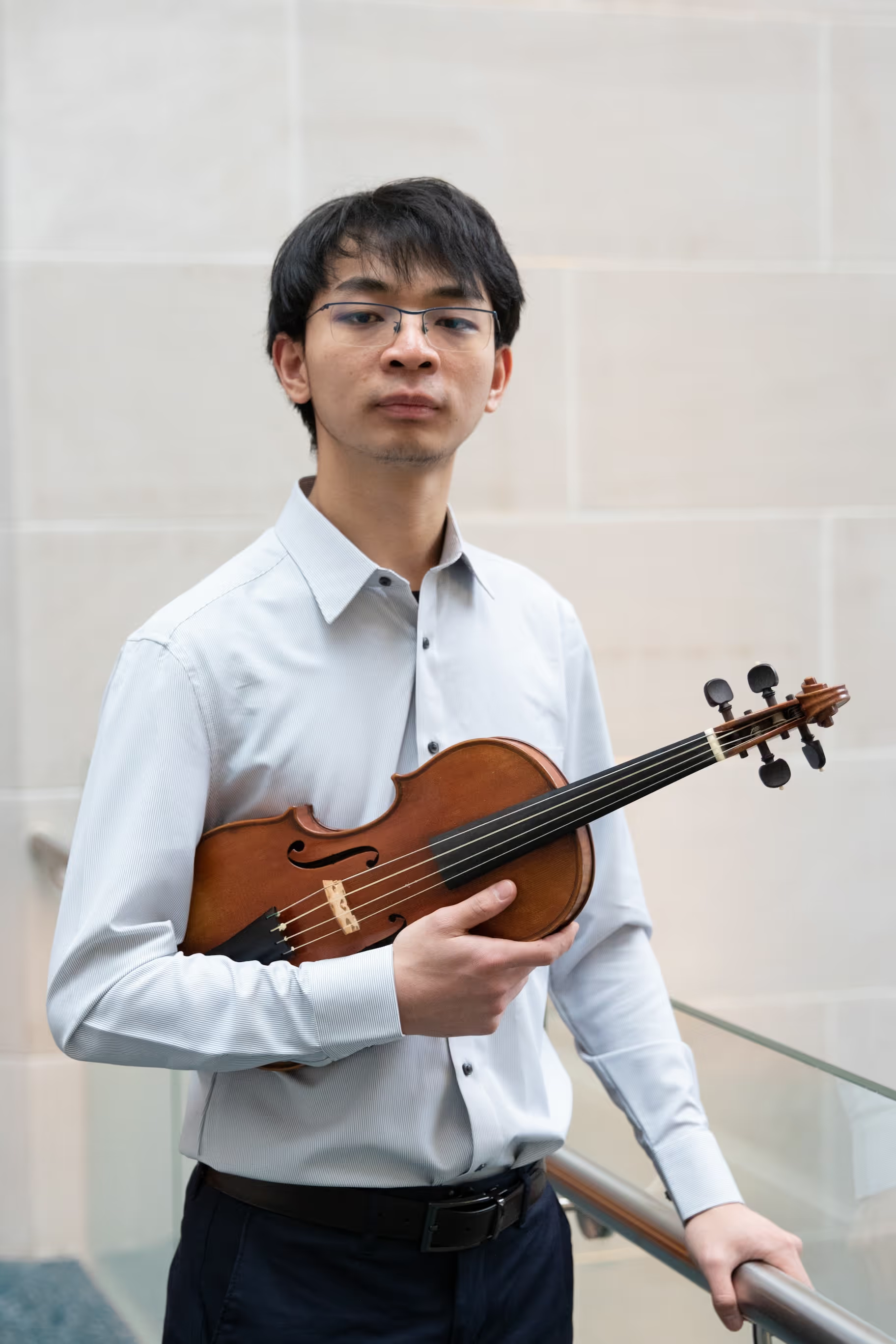
Violinist Ryan Cheng has performed widely across the United States, Europe and Asia. Notable performances and collaborations include the MAFestival Brugge with Juilliard415 and Stephan MacLeod, Juilliard415 with Francesco Corti, American Bach Soloists, California Bach Society, the faculty of San Francisco Conservatory of Music (SFCM), the Boston Early Music Festival, and he will be appearing with the Smithsonian Viol Consort in 2024. He has won the Juilliard Historical Performance Concerto Competition and the SFCM Baroque Concerto Competition and participated in the 2022 Leipzig International Bach Competition.
In addition to the Orbis Pictus Ensemble, Ryan is a part of The Fooles, a baroque ensemble dedicated to 17th century Italian repertoire, which won the Association des Centres Culturels de Rencontre residency at Thiré with Les Arts Florissants. He is also a founding member of the Innominatum Baroque Ensemble, with which he plays violin and viol, and the Orbis Pictus Ensemble. Previous to studying at Juilliard, Ryan has studied at the San Francisco Conservatory with Ian Swensen and at the Eastman School of Music with Robin Scott and Bin Huang. Ryan is especially interested in experimenting with historical playing techniques.
